

FALSE in Calligra Sheets: Create an Explicit Boolean False Value
Learn Calligra Sheets FALSE with exact arguments, reproducible inputs, independently checked results and implementation-specific cautions.
Verification status: See the evidence and test scope described in this guide. How formula examples are checked
Quick answer
FALSE() returns the Boolean value false. Use it when a formula needs an explicit logical value, such as a default disabled flag. It does not evaluate a condition and is not the text string "FALSE".
Syntax
=FALSE()
There are zero arguments, so the parentheses are empty. The release registration explicitly enforces zero parameters and the implementation returns Value(false). No optional argument or default input exists. The visible word may be localized; the underlying Boolean is the important result.
Reproduce the value and two uses
Enter these formulas into separate cells:
| Cell | Formula | Expected result |
|---|---|---|
| B2 | =FALSE() |
Boolean false |
| B3 | =NOT(FALSE()) |
Boolean true |
| B4 | =IF(FALSE();"Enabled";"Disabled") |
Text Disabled |
These outcomes follow the Boolean definition and source implementation; no native execution is claimed. The third example returns the false branch because the condition is false. Quotation marks around Enabled and Disabled make those branches text labels, while FALSE() itself remains a logical value.
Practical example: an explicit optional adjustment
Put 100 in A2, 20 in B2 and =FALSE() in C2. Then enter:
=IF(C2;A2+B2;A2)
Expected: 100. Replacing C2 with =TRUE() changes the expected result to 120. This creates a visible include-adjustment flag, rather than burying the choice inside the total formula. Label C2 clearly so a reviewer knows what a true flag enables.
A constant FALSE() is not a test of whether the adjustment is valid. If the decision should depend on another input, use a condition expressing that rule instead of a permanently false constant.
Common mistakes and compatibility
=FALSE(1)supplies an argument to a zero-argument function; it is not a test of 1.="FALSE"returns text, not the Boolean constant. Conversion of that text in other functions should not be assumed.- A blank cell is also not the same data type. Use a Boolean flag when a later formula expects a clear true/false decision.
- Numeric zero and Boolean false may be coerced similarly in some expressions, but that does not make them interchangeable for every function or imported workbook.
- FALSE does not mean a calculation failed. It can be a valid logical result.
The KDE logical-function reference and release source establish the zero-argument function. During cross-program transfers, preserve Boolean values as Booleans rather than localized display text; test any formulas that depend on coercing text or numbers into logical values separately.
Availability and verification
- Release checked: Calligra Sheets 26.08.2, using KDE’s release source package and release information, inspected on October 18, 2026. Relevant locations:
sheets/functions/logic.cpplines 35–37 and 141–144. - Introduced: The original introduction version is not established by these sources. Current registration establishes presence in 26.08.2, not the first release.
- Lifecycle: Registered in the inspected release; no retirement or deprecation marker was found in this function’s registration. Retirement (removed support) and deprecation (discouraged but retained support) are different claims; neither is asserted here.
- Native testing: Selected cases were observed in Calligra Sheets 25.04.2, as detailed below. The source discussion concerns 26.08.2; unlisted cases remain source-derived or independently calculated.
Related guides and sources
- NOT
- IF
- AND
- Calligra function guide index
- KDE formula entry instructions, checked October 18, 2026. Examples use leading
=and semicolons, with a period for decimal numbers. Confirm regional separators in your installation before pasting.
Selected native results and screenshot
The following results were observed in Calligra Sheets 25.04.2 using an ODS workbook opened, calculated and saved by the application. The formula text below uses worksheet notation; saved ODF reference brackets are omitted for readability. Unlisted examples and edge cases retain their separate source or mathematical evidence.
| Native formula | Observed display |
|---|---|
=FALSE() |
false |
=NOT(FALSE()) |
true |
=IF(FALSE();"Yes";"No") |
No |
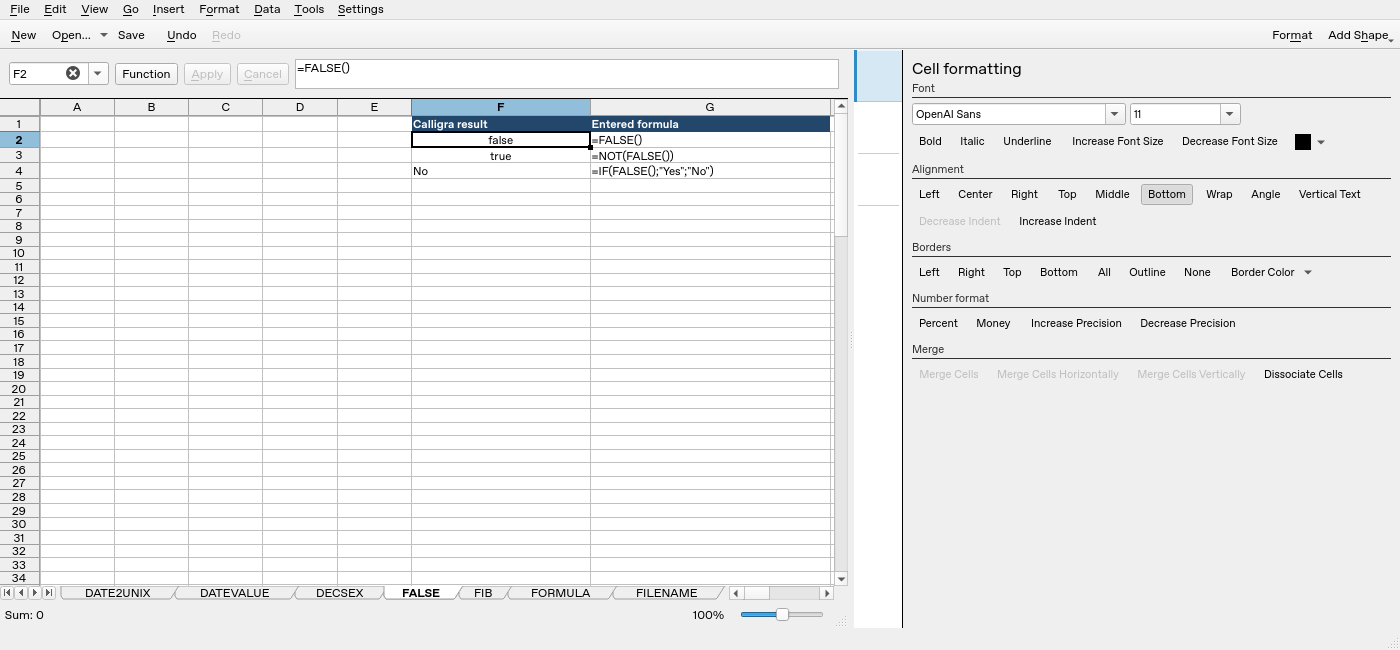
Screenshot: Native 25.04.2 capture with F2 selected. The formula bar shows =FALSE(); column F contains application results. Column G contains descriptive formula labels, some of which are clipped by the formatting panel.