

FIB in Calligra Sheets: Calculate Small Positive Fibonacci Terms
Learn Calligra Sheets FIB with exact arguments, reproducible inputs, independently checked results and implementation-specific cautions.
Verification status: See the evidence and test scope described in this guide. How formula examples are checked
Quick answer
FIB(n) returns the nth Fibonacci term for the positive-integer examples in this guide: 1, 1, 2, 3, 5, 8, and so on. Use it for small sequence demonstrations and recurrence checks. The implementation uses floating-point powers, so it is not an arbitrary-precision integer sequence generator.
Syntax and a zero-input discrepancy
=FIB(n)
One numeric argument is required, with no optional arguments. Use a positive whole number. The source rejects nonnumeric values and values not greater than zero. It does not explicitly require that a positive input be integral, but fractional inputs are outside the integer-sequence use case and should not be treated as supported sequence indices.
The KDE FIB entry describes a zero term of 0. The inspected 26.08.2 implementation instead rejects n <= 0 with a numeric error. This guide follows the source for that boundary and does not promise FIB(0)=0. The native 25.04.2 check below confirms #NUM! for zero.
Reproduce small terms
- Enter Term and Fibonacci into A1:B1.
- Put 1, 2, 3, 9 and 26 into A2:A6.
- Enter
=FIB(A2)in B2 and fill down through B6.
| Input n | Independent expected term |
|---|---|
| 1 | 1 |
| 2 | 1 |
| 3 | 2 |
| 9 | 34 |
| 26 | 121393 |
The expectations were calculated using an integer recurrence starting from 1 and 1, not by running Calligra or duplicating its power formula. Displaying zero decimal places makes a small floating-point residual less distracting, but does not turn the underlying implementation into exact integer arithmetic.
Advanced check: compare with a recurrence column
Enter 1 in D2 and 1 in D3. In D4 enter =D2+D3 and fill down through D10. This independently constructed recurrence yields 1, 1, 2, 3, 5, 8, 13, 21, 34. Beside it, put indices 1 through 9 in C2:C10 and use =FIB(C2) in E2, filled down.
Compare E and D with a sensible numerical tolerance, for example =ABS(E2-D2)<0.000001 for these small terms. Expected results are true throughout this small example. The tolerance is for this scale, not a universal guarantee for large n. Such a comparison helps distinguish a wrong index from insignificant floating-point noise.
Errors, precision and portability
- The source explicitly returns a value error for text such as
FIB("9"); supply numeric 9. - Zero and negative indices take the numeric-error branch in the inspected release, despite the handbook’s zero-term sentence.
- Large terms quickly exceed exact floating-point integer representation; eventually powers may overflow. No safe large-n limit is asserted without testing the build and number representation.
- The implementation computes a closed-form expression involving square root and powers. Rounding the displayed result is not proof of exactness.
- Fractional n can involve powers of a negative base and is not a well-defined request for the nth integer-indexed term in this tutorial.
- Index conventions vary: some sequence lists start at zero, others at one. This guide uses F(1)=1 and F(2)=1.
The source labels FIB as a Calligra-specific function. Do not assume another spreadsheet recognizes the name. A recurrence column is often the clearest portable alternative for a small teaching example; specialized integer tools are more appropriate when exact very large terms matter.
Availability and verification
- Release checked: Calligra Sheets 26.08.2, using KDE’s release source package and release information, inspected on October 18, 2026. Relevant locations:
sheets/functions/math.cppregistration at 137 and implementation at 1052–1083;sheets/functions/math.xmlFIB help. - Introduced: The original introduction version is not established by these sources. Current registration establishes presence in 26.08.2, not the first release.
- Lifecycle: Registered in the inspected release; no retirement or deprecation marker was found in this function’s registration. Retirement (removed support) and deprecation (discouraged but retained support) are different claims; neither is asserted here.
- Native testing: Selected cases were observed in Calligra Sheets 25.04.2, as detailed below. The source discussion concerns 26.08.2; unlisted cases remain source-derived or independently calculated.
Related guides and sources
- SQRT
- POWER
- ABS
- Calligra function guide index
- KDE formula entry instructions, checked October 18, 2026. Examples use leading
=and semicolons, with a period for decimal numbers. Confirm regional separators in your installation before pasting.
Selected native results and screenshot
The following results were observed in Calligra Sheets 25.04.2 using an ODS workbook opened, calculated and saved by the application. The formula text below uses worksheet notation; saved ODF reference brackets are omitted for readability. Unlisted examples and edge cases retain their separate source or mathematical evidence.
| Native formula | Observed display |
|---|---|
=FIB(1) |
1.0000000000 |
=FIB(2) |
1.0000000000 |
=FIB(3) |
2.0000000000 |
=FIB(9) |
34.0000000000 |
=FIB(26) |
121393.0000000001 |
=FIB(0) |
#NUM! |
The mathematical value of FIB(26) is 121393. The native ten-decimal display was 121393.0000000001, demonstrating the floating-point approximation discussed above; the saved numeric serialization rounded to 121393. FIB(0) displayed #NUM!.
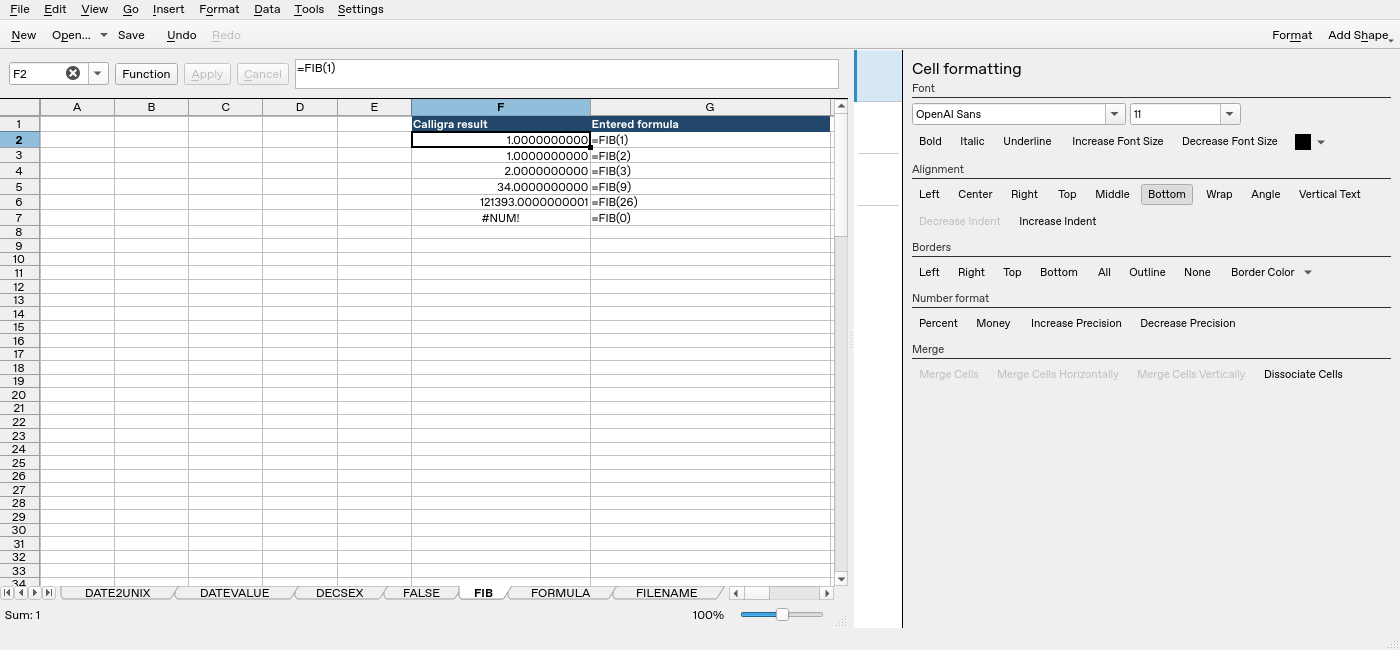
Screenshot: Native 25.04.2 capture with F2 selected. The formula bar shows =FIB(1); column F contains application results. Column G contains descriptive formula labels, some of which are clipped by the formatting panel.