

PERMUTATIONA in Calligra Sheets: Count Ordered Choices with Repetition
Count ordered sequences when choices may repeat, with integer conversion and zero-case checks.
Verification status: Consult the documentation, examples and any stated test scope below. How formula examples are checked
Quick answer: =PERMUTATIONA(3;4) returns the mathematical count 81. There are three choices for each of four ordered positions, and a choice can be reused, so the count is 3⁴.
The order matters: sequences AABB and ABAB are different. Repetition is allowed: AAAA is valid. Those two rules distinguish this function from combinations or permutations without replacement.
Syntax and defaults
=PERMUTATIONA(total; chosen)
Both arguments are required and have no defaults. Total is the number of choices available at each position; chosen is the number of positions in the sequence. For counting, use nonnegative integers. The source converts both inputs to integers, rejects a negative converted value and computes total raised to chosen.
There is no restriction that chosen ≤ total when repetition is allowed. For example, two symbols can form a three-position code: 2³ = 8. The result counts sequences, not the probability of a particular one.
Worked worksheet: ordered equipment settings
A prototype has four independent setting positions. Each position can use one of three labels: A, B or C. Labels may repeat.
- Enter 3 in B2 labeled
Choices per position. - Enter 4 in B3 labeled
Number of positions. - In B5 enter
=PERMUTATIONA(B2;B3). - Expected B5 is 81 distinct ordered settings.
- Check the direct power with
=B2^B3; it also gives 81.
This formula assumes every position has the same three choices and all combinations are permitted. If a rule forbids adjacent repeats or certain pairings, 81 overcounts the permitted settings. PERMUTATIONA does not inspect those constraints.
Advanced example: unequal choices require a different product
Suppose three positions have 2, 3 and 4 possible choices respectively. The independent count is 2×3×4 = 24. A single PERMUTATIONA(total;chosen) call does not describe unequal choice counts per position.
If choices are equally likely and independent in the original 3-by-4 example, each specific sequence would have probability 1/81. Uniform probability is an additional assumption: the sequence count alone says nothing about how frequently a process selects each option.
Zero cases and integer conversion
| Formula | Independent or source-defined result | Meaning |
|---|---|---|
PERMUTATIONA(2;3) |
8 | Two reusable choices for three ordered positions. |
PERMUTATIONA(3;0) |
1 | One empty sequence with zero positions. |
PERMUTATIONA(0;3) |
0 | No sequence can fill positive positions from no choices. |
PERMUTATIONA(0;0) |
1 | The source’s zero-power convention and handbook example. |
PERMUTATIONA(2.9;3.9) |
8 | Positive inputs are converted downward to 2 and 3 before exponentiation. |
The last row is a conversion behavior, not a meaningful fractional-count model. Enter the intended integers explicitly. The handbook says parameters must be positive but also gives (0,0) as an example; the source permits nonnegative converted values, resolving that wording ambiguity.
Errors, limits and related functions
A negative input such as PERMUTATIONA(-1;2) triggers an internal value error after integer conversion. Text and Boolean conversion should not be used as count validation. Large powers can overflow or lose integer precision in numeric storage; no arbitrary-precision counting guarantee is established here. Displaying a whole number does not prove it is exact at every magnitude.
KDE PERMUT counts ordered selections without repetition; KDE COMBIN ignores order. For an ordinary positive example, PERMUTATIONA(3;2) is 9, whereas selecting two different choices in order gives 3×2 = 6. Choose the rule that matches the task before selecting the function.
Availability, sources and evidence scope
Checked October 18, 2026. Original introduction date is unknown. PERMUTATIONA is registered in both inspected source versions, Calligra 25.04.2 and 26.08.2. Their relevant statistical-function, calculation-engine and converter source files are byte-identical. Version inspection establishes availability in those releases, not a first-introduction date or a runtime guarantee for every platform.
Primary sources: KDE PERMUTATIONA handbook, 26.08.2 implementation, 25.04.2 statistical functions, and numeric converter. Mathematical values above are independent calculations. Native observations below were obtained in Calligra Sheets 25.04.2 on Linux, October 18, 2026; no native 26.08.2 execution is claimed. The handbook is a living reference and can differ from the pinned implementation at the explicitly described boundaries.
Native verification in Calligra Sheets 25.04.2
The following formula results were obtained in the actual application and checked in its completed native-saved workbook. The screenshot is an unmodified application capture. The values in this table are native results; the earlier reference values and model calculations remain separately identified. Small final-digit differences do not make the independent reference a native observation.
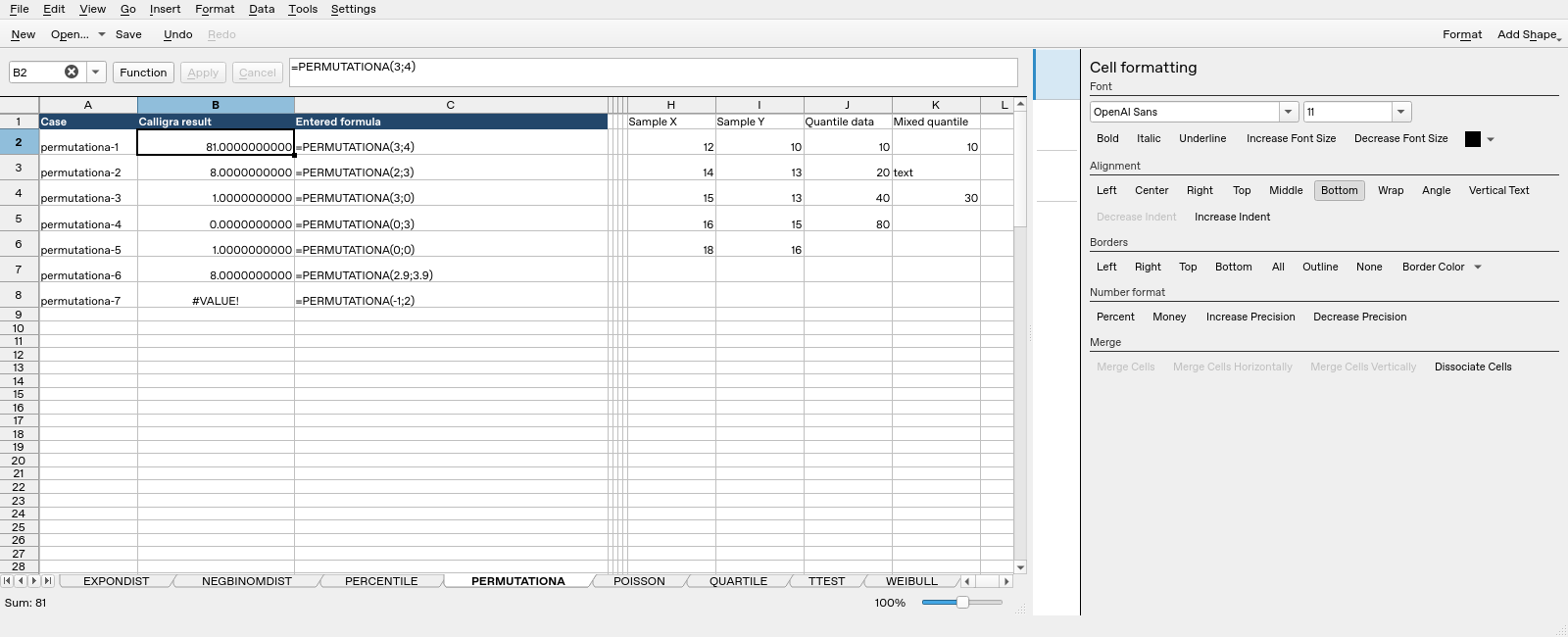
| Formula executed | Native saved result |
|---|---|
=PERMUTATIONA(3;4) |
81 |
=PERMUTATIONA(2;3) |
8 |
=PERMUTATIONA(3;0) |
1 |
=PERMUTATIONA(0;3) |
0 |
=PERMUTATIONA(0;0) |
1 |
=PERMUTATIONA(2.9;3.9) |
8 |
=PERMUTATIONA(-1;2) |
#VALUE! |
The completed saved values, including error text, determine this table; display rounding can show fewer digits. These tests do not establish all locales, input types, extreme numerical ranges or cross-application import behavior.