

AMORDEGRC Function (Gnumeric)
Calculate coefficient-based declining depreciation for a selected accounting period in Gnumeric, including first-period proration and whole-unit rounding.
Verification status: See the evidence and test scope described in this guide. How formula examples are checked
AMORDEGRC returns depreciation for a selected accounting period using the French-convention algorithm described in Gnumeric’s help. It adjusts the rate by an asset-life coefficient and prorates the first period. The result is that period’s depreciation charge, not cumulative depreciation or the asset’s remaining book value. This tutorial demonstrates software behavior with a synthetic asset, not current tax or accounting advice.
Seven required arguments
=AMORDEGRC(cost,purchase_date,first_period,salvage,period,rate,basis)
All seven arguments are required by the inspected 1.12.57 registration. cost is the original amount; purchase_date and first_period are the acquisition date and end of the first accounting period. salvage is the residual value, period selects the charge, and rate is a decimal annual depreciation rate. period 0 selects the initial prorated charge; period 1 selects the following charge.
basis controls the year fraction: documented values are 0 US 30/360, 1 actual/actual, 2 actual/360, 3 actual/365 and 4 European 30/360. Supply explicit dates and a positive rate. A decimal such as 0.2 represents 20%; entering 20 changes the implied asset life and coefficient completely.
Coefficient and rounding
The algorithm uses an implied life of 1/rate. It applies coefficient 1 below three years, 1.5 from three up to but excluding five years, 2 from five through six years, and 2.5 above six years. The coefficient multiplies the supplied rate. Depreciation calculations are rounded to whole units in this implementation, rather than automatically to two currency decimal places.
The first charge is the year fraction from purchase to first-period end multiplied by adjusted rate and initial cost, then rounded. Later charges use the remaining depreciable book amount, subject to the algorithm’s special end-period behavior. Rounding and the first-period fraction can make a naïve fixed-percentage schedule differ from this function.
Two independently reproducible charges
For cost 1000, purchase January 1, 2024, first-period end January 1, 2025, salvage 100, rate 0.2 and basis 0:
=AMORDEGRC(1000,DATE(2024,1,1),DATE(2025,1,1),100,0,0.2,0)
=AMORDEGRC(1000,DATE(2024,1,1),DATE(2025,1,1),100,1,0.2,0)
Expected results are 400 and 240 respectively. The implied life is five years, coefficient 2, and adjusted rate 0.4. The first full-year charge is 1000×0.4 = 400. The remaining amount is 600, so the next ordinary charge is 600×0.4 = 240. Both values are integers already, avoiding a rounding-boundary ambiguity in the control.
For a schedule, keep the six asset/date/rate/basis inputs fixed and put successive period numbers in a separate column. Each formula should still receive the original cost and acquisition dates. Do not feed the previous row’s reduced cost back as a new asset cost; the function already performs its own internal progression.
End periods and validation
The official help explicitly warns that special treatment in the final two periods can make total depreciation exceed cost minus salvage. Do not assume the function is a simple salvage-capped declining balance. Review the entire resulting schedule before using it in an accounting workflow, and use the applicable professional rules separately from this software example.
The inspected callback rejects a negative rate, invalid basis or unconvertible dates with #NUM!. It does not comprehensively validate every economically unusual cost, salvage, date ordering or period combination. period is converted to an integer; supply nonnegative integers deliberately. Zero rates, fractional periods and extreme inputs are not covered by these native fixtures and should not be inferred safe or meaningful from the positive examples.
Official NEWS introduces AMORDEGRC in Gnumeric 1.1.6. This history does not establish compliance with present-day accounting rules, nor identical rounding and edge behavior in other spreadsheet programs.
Verification scope and sources
On October 17, 2026, Gnumeric ssconvert 1.12.57 under C.UTF-8 recalculated the synthetic FinancialTraffic fixture. Native results were F5 = 400; F6 = 240. The earlier fixture uses the exact literal formulas described above. A separate native Gnumeric 1.12.57 screenshot below shows the primary example only. Other edge cases are source-derived unless explicitly identified as tested. No native 1.12.62 execution is claimed. Official 1.12.57 source was retrieved October 17, 2026. Retained release history from the official 1.12.62 source was originally obtained October 13–14, 2026 and reviewed October 17; it is not a fresh runtime test.
Related Gnumeric guides
Native application screenshot
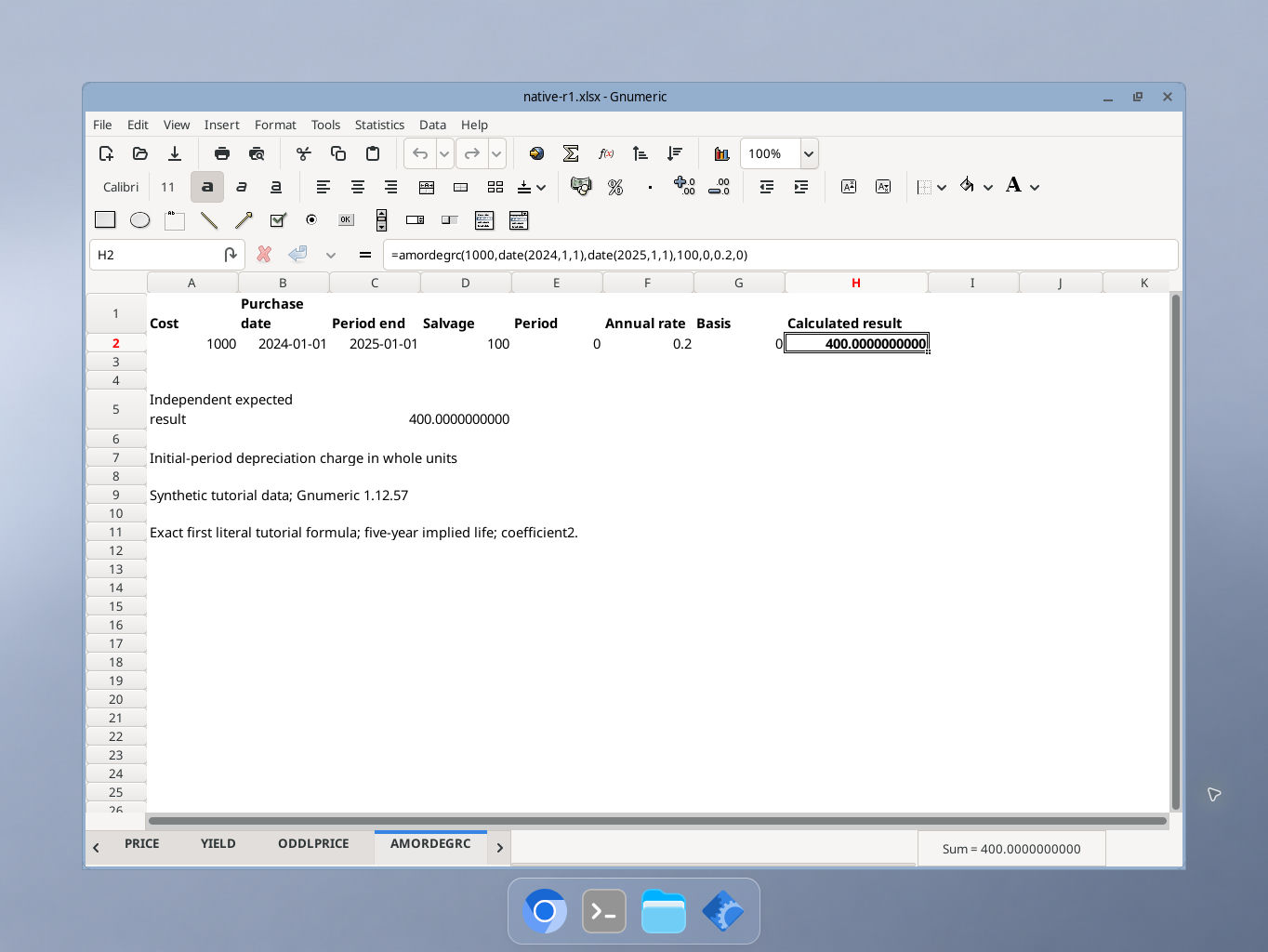
Gnumeric 1.12.57, captured October 17, 2026. Selected cell H2 shows 400.0000000000 for the initial-period charge. The formula bar and synthetic inputs are visible. GUI locale was not independently recorded; this capture covers the primary example only.