

MPSEUDOINVERSE Function (Gnumeric)
Compute numerical matrix pseudoinverses in Gnumeric with MPSEUDOINVERSE, rectangular array output, relative thresholds and least-squares checks.
Verification status: Gnumeric 1.12.57 ssconvert: specified MPSEUDOINVERSE fixtures and separately captured worked-example GUI. Gnumeric 1.12.62 source inspected separately. How formula examples are checked
MPSEUDOINVERSE returns a numerical pseudoinverse of a matrix. Unlike an ordinary inverse, a pseudoinverse can be useful for rectangular matrices and rank-deficient models. It does not make an underdetermined problem uniquely identifiable; the result reflects a particular minimum-norm or least-squares construction and the numerical threshold used to discard small directions.
Syntax and result shape
=MPSEUDOINVERSE(matrix[,threshold])
matrix is required and must be a nonempty numeric matrix. threshold is optional: the function help describes it as a relative cutoff for discarding eigenvalues. The retained callback defaults it to 256 times Gnumeric’s floating-point epsilon. On the ordinary double-precision build that is approximately 5.684341886080802e-14. It is not an absolute cutoff measured in the same units as every input entry, nor a requested number of decimal places.
For an m-row by n-column input, the result has n rows and m columns. Select that full destination rectangle, type the formula and press Ctrl+Shift+Enter for Gnumeric array entry. Do not manually type braces. Exclude headings and use explicitly numeric cells; matrix positions must not shift because a label or missing value was included.
Worked example: a tall matrix
Enter this matrix in A1:B3:
| Row | A | B |
|---|---|---|
| 1 | 1 | 0 |
| 2 | 0 | 1 |
| 3 | 1 | 1 |
Select D1:F2 and array-enter =MPSEUDOINVERSE(A1:B3). The expected result is:
| D | E | F | |
|---|---|---|---|
| 1 | 2/3 | -1/3 | 1/3 |
| 2 | -1/3 | 2/3 | 1/3 |
The cells contain numeric approximations such as 0.666666666666667, not literal fractional text. Independently, A has full column rank, so its pseudoinverse is (AᵀA)⁻¹Aᵀ. Here AᵀA is [[2,1],[1,2]], whose inverse is one-third of [[2,-1],[-1,2]]. Multiplying gives the displayed 2×3 result.
Select H1:I2 and array-enter =MMULT(D1:F2,A1:B3). The expected result is the 2×2 identity matrix. The opposite multiplication has shape 3×3 and is a projection, not the 3×3 identity. This distinction is important when checking rectangular matrices.
Advanced use: least-squares coefficients
Put observations 1, 2, 4 in K1:K3. Select M1:M2 and array-enter =MMULT(D1:F2,K1:K3). The expected fitted coefficients are 4/3 and 7/3. Their fitted observations are 4/3, 7/3 and 11/3. The residuals, observed minus fitted, are -1/3, -1/3 and 1/3; the residual sum of squares is 1/3.
This example cannot satisfy all three equations exactly, and the pseudoinverse does not pretend otherwise. Keep residuals visible. If you need an intercept in a regression design, include its column of ones explicitly rather than assuming matrix algebra adds one.
Threshold sensitivity and troubleshooting
A deliberately large threshold can suppress a numerically small direction and change the fitted model. For a separate 2×2 diagonal matrix [[1,0],[0,0.01]], the ordinary pseudoinverse is [[1,0],[0,100]]. Using threshold 0.1 suppresses the small direction in the tested fixture and returns [[1,0],[0,0]]. That is a substantive modeling change, not merely rounding 100 to fewer digits.
- An empty matrix produces
#VALUE!in the retained callback. A nonempty rectangular matrix is not automatically an error. - The function is not restricted to nonsingular square inputs. Do not substitute MINVERSE’s input conditions for this function’s contract.
- Do not rely on undocumented behavior for negative, nonfinite or arbitrarily large thresholds. Choose a justified nonnegative relative cutoff and compare the result with the default.
- Check A×A⁺×A against A when the retained directions are meant to reconstruct the original matrix. Small discrepancies are expected with floating arithmetic; deliberate truncation can produce larger differences.
- If output is missing columns, verify the reversed dimensions and the array-entry range before changing the mathematics.
Version and evidence
Official NEWS identifies MPSEUDOINVERSE as added in Gnumeric 1.12.3. Syntax, shape and default cutoff were inspected in retained 1.12.62 source; no retirement or last functioning version is inferred. Gnumeric 1.12.57 ssconvert independently recalculated the full 2×3 worked result on 17 October 2026 in C.UTF-8. The least-squares example is checked by exact algebra, not a claimed separate native run. A separate worked-example GUI capture is documented below.
Related functions
Official sources
The same native 1.12.57 engine session also confirmed the diagonal threshold example: the omitted threshold returned diagonal entries 1 and 100; threshold 0.1 returned 1 and 0. This verifies those two choices, not arbitrary cutoff boundaries.
Native application screenshot
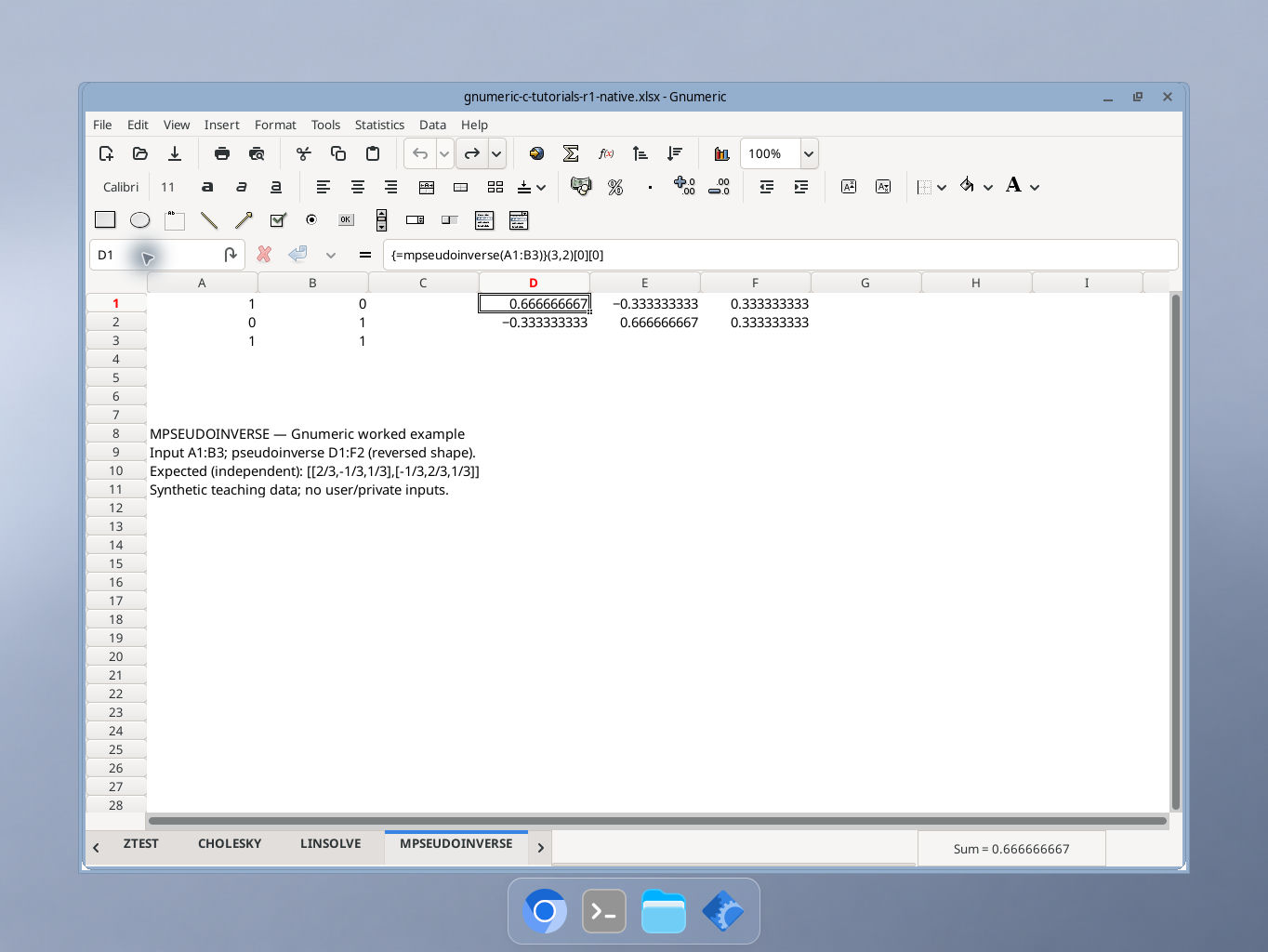
Gnumeric 1.12.57, captured 17 October 2026. Input A1:B3; pseudoinverse D1:F2 (reversed shape). The selected cell D1 shows the formula in the formula bar. Display precision is shorter than the independent reference values; integer cells may show a trailing decimal point. GUI locale was not independently recorded.