

POLA in Calligra Sheets: Find an Unsigned Polar Angle
Convert Cartesian coordinates to an angle while recognizing the loss of the y-coordinate sign.
Verification status: Consult the documentation, examples and any stated test scope below. How formula examples are checked
Quick answer: =POLA(3;4) has reference value 0.927295218002 radians, approximately 53.1301023542°. In the inspected implementation, =POLA(3;-4) gives the same angle. POLA therefore does not retain a point’s full signed direction.
Syntax and the actual calculation
=POLA(x; y)
Both coordinates are required and must use the same length unit. The return value is in radians. The implementation calculates the radius from x and y, then evaluates acos(x/radius). For ordinary finite nonzero inputs, the resulting angle lies between 0 and π.
Because the radius depends on squared coordinates, replacing y by −y does not change the answer. This folds points below the x-axis onto their reflected points above it. It is a useful unsigned angular separation from the positive x-axis, but it is insufficient for navigation, heading or a general Cartesian-to-polar round trip.
Worked worksheet: an unsigned geometric angle
- Enter
x (m)in A1,y (m)in B1, 3 in A2 and 4 in B2. - In C2 enter
=POLA(A2;B2). The mathematical reference is 0.927295218002 radians. - In D2 enter
=C2*180/PI(). The expected angle is approximately 53.1301023542 degrees. - Set B2 to −4. POLA’s reference value is unchanged.
- Set A2 to −3, retaining either sign of 4 in B2. The angle becomes approximately 2.21429743559 radians, or 126.869897646 degrees.
The sign experiment is part of understanding the function, not a rounding test. Both (3,4) and (3,−4) are five metres from the origin, and both have x/radius = 0.6. Their signed directions nevertheless differ.
Advanced example: reconstructing coordinates
For the first point, radius 5 with cosine and sine of POLA’s result reconstructs x = 3 and y = 4. For the point (3,−4), the same reconstruction gives positive 4, losing the original y sign. Storing only radius and POLA’s angle is therefore not a reversible representation of all Cartesian points.
If you only need an angle between a vector and the positive x-axis, that ambiguity may be acceptable. If you need orientation, keep both coordinates and use an explicitly signed-angle calculation. The Calligra ATAN2 guide documents the tested software-specific argument order; do not borrow another spreadsheet’s order without checking it.
Boundaries and numerical cautions
At (0,0), there is no direction. The source detects zero radius and returns a division-by-zero error. At (4,0), the angle is zero; at (−4,0), the mathematical result is π; at (0,4) or (0,−4), it is π/2.
The radius implementation uses arithmetic on squared coordinates. Extremely large components can overflow before the square root, while tiny values can lose information. This guide establishes ordinary finite examples, not a robust all-magnitude hypot implementation. Near the x-axis, rounding of x/radius can also matter to acos. Do not infer a precise small angle solely from a heavily rounded coordinate ratio.
A common unit mistake is interpreting the raw result as degrees. POLA(3;4) is about 0.9273 radians, not 0.9273 degrees. Scale both coordinates consistently; multiplying both by the same positive factor should leave the mathematical angle unchanged.
Compatibility
POLA is a software-specific name. A function called ATAN2, a programming-language atan2(y,x), or a signed polar conversion is not automatically equivalent. When moving a workbook, test points in all four quadrants and the origin, and decide whether preserving the y sign is essential to the task.
Version scope and references
Reviewed October 18, 2026. The relevant implementation file and shared numerical/conversion files were compared between official 25.04.2 and 26.08.2 source and are byte-identical. This establishes source equivalence for the inspected code, not identical behavior on every platform or a native test of 26.08.2. The earliest release containing POLA has not been established; these version numbers are not introduction dates.
Mathematical reference values above were calculated independently. The native results below were obtained in Calligra Sheets 25.04.2 on Linux, October 18, 2026; no native 26.08.2 execution is claimed. No unstated locale, import or array-entry behavior is implied.
Native verification in Calligra Sheets 25.04.2
These formulas were recalculated in the actual application and read back from its completed native-saved workbook. The image is an unmodified application screenshot. The earlier mathematical calculations remain independent references; this table records actual saved results.
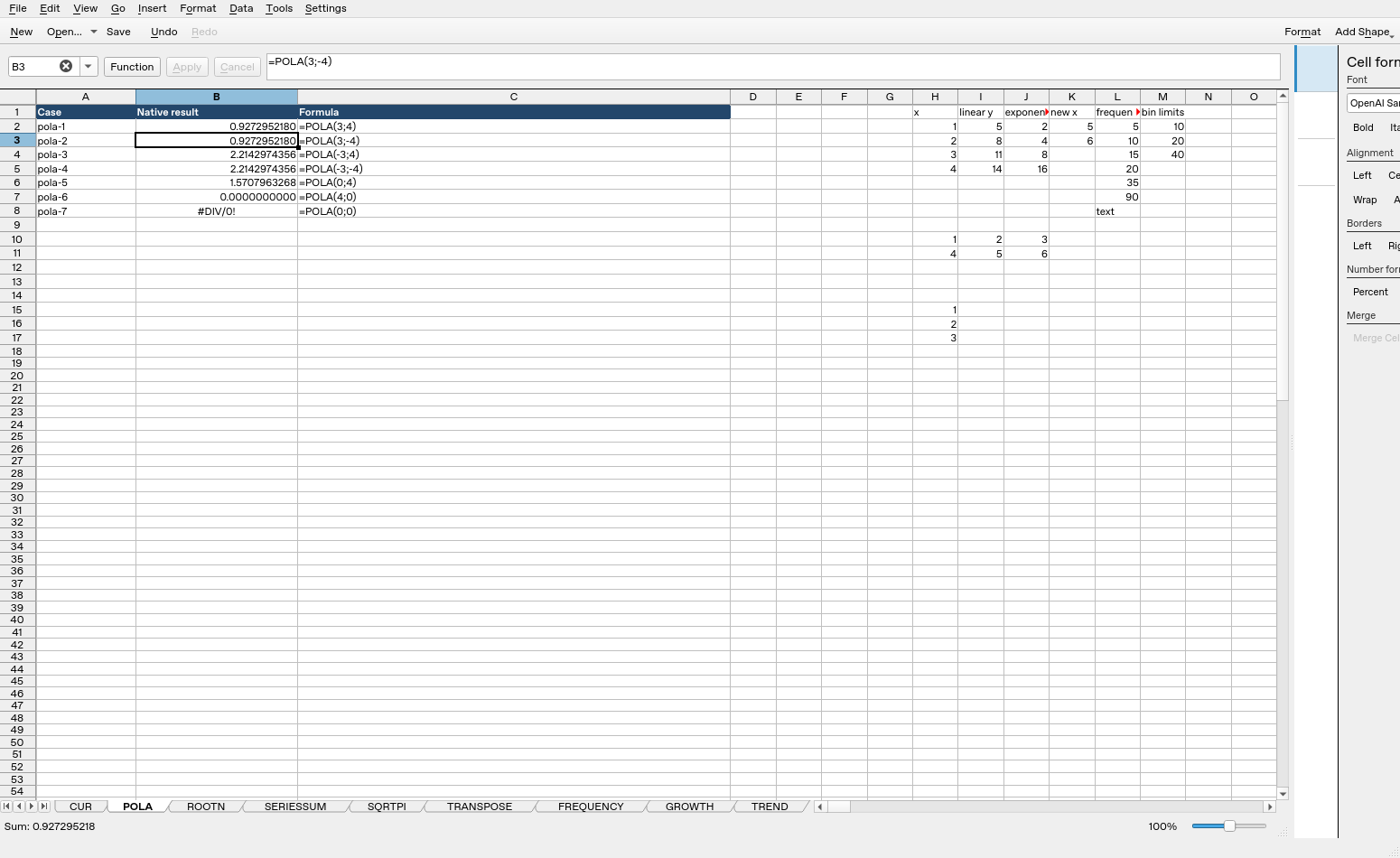
| Formula executed | Native saved result |
|---|---|
=POLA(3;4) |
0.927295218001612 |
=POLA(3;-4) |
0.927295218001612 |
=POLA(-3;4) |
2.21429743558818 |
=POLA(-3;-4) |
2.21429743558818 |
=POLA(0;4) |
1.5707963267949 |
=POLA(4;0) |
0 |
=POLA(0;0) |
#DIV/0! |
Display formatting may show fewer digits than the saved value. The tested cases do not establish every coercion, extreme magnitude or cross-application import behavior.