

ISEVEN Function (Gnumeric)
Test parity in Gnumeric with ISEVEN, truncation of fractional values, negative inputs and integer-validation cautions.
Verification status: Fresh bounded Gnumeric 1.12.57 source and native engine verification; separate primary-example GUI capture below. How formula examples are checked
Exact syntax and meaning
=ISEVEN(value)
ISEVEN returns TRUE if the integer part of its required numeric argument is even, and FALSE if it is odd. It is a logical predicate, not a rounding function and not a complete test that the original value was an integer.
The preserved example =ISEVEN(8) returns TRUE; =ISEVEN(9) returns FALSE. Zero is even, so =ISEVEN(0) returns TRUE. The recorded fractional cases show truncation toward zero for parity: ISEVEN(2.9) and ISEVEN(-2.9) return TRUE because the integer parts are 2 and -2. ISEVEN(-3.9) returns FALSE because the integer part is -3.
This differs from first rounding to the nearest integer: rounding 2.9 to 3 and testing parity would give a different answer. It also differs from mathematical floor for negative fractions; floor(-2.9) is -3, while this parity test uses the truncated integer part -2.
Advanced application: validate even whole counts
If an input must be a whole even count rather than merely have an even integer part, check both conditions. For a numeric value in A2, =AND(A2=TRUNC(A2),ISEVEN(A2)) expresses the mathematical rule. With A2=8 it is TRUE; with A2=2.9 it is FALSE even though ISEVEN alone is TRUE. This derived application is an independently reasoned formula, not a separately recorded native fixture.
A domain-specific rule may also require nonnegative values. For paired packaging, for example, a negative even count is mathematically even but may not be a valid requested quantity. Keep those validation rules separate so that the parity result is not mistaken for overall data validity.
Errors and numerical limits
The nonnumeric text “bad” returned #VALUE! in the native test. Do not turn an error into FALSE automatically unless that loss of distinction is intentional. An odd numeric count and an unrecognized input are different problems even if a display rule happens to show the same message for both.
At large magnitudes a floating-point number may no longer represent every consecutive integer. ISEVEN can only inspect the stored number, so it cannot recover the parity of digits already rounded during import or calculation. Keep exact identifiers as text if their final digit matters and validate them with a text-based rule instead. The bounded fixtures here do not establish an exact-integer cutoff for every build.
Recorded native examples
=ISEVEN(8)→ True=ISEVEN(9)→ False=ISEVEN(2.9)→ True=ISEVEN(-2.9)→ True=ISEVEN(-3.9)→ False=ISEVEN(0)→ True=ISEVEN("bad")→ #VALUE!
Version and verification scope
Original introduction and last functioning release are not established. The retained historical registration check documented availability in Gnumeric 1.12.62 on 14 October 2026, on desktop installations with fn-info included and enabled. That registration evidence is separate from the fresh Gnumeric 1.12.57 source inspection and bounded ssconvert run on 17 October 2026. No 1.12.62 execution is claimed.
Input formulas, saved results and evidence-file hashes were independently verified. Numeric results match elementary arithmetic or Python mathematical references to absolute/relative tolerance 1e-12; logical and error outputs match exactly. These records are engine evidence; the separate primary-example GUI capture below is not an extreme-input guarantee. Earlier comparable LibreOffice Calc 25.2 checks are historical context rather than Gnumeric native evidence. Shared function names do not establish identical coercion, rounding, numerical range or errors in other programs.
Related functions
First-party sources
Native application screenshot
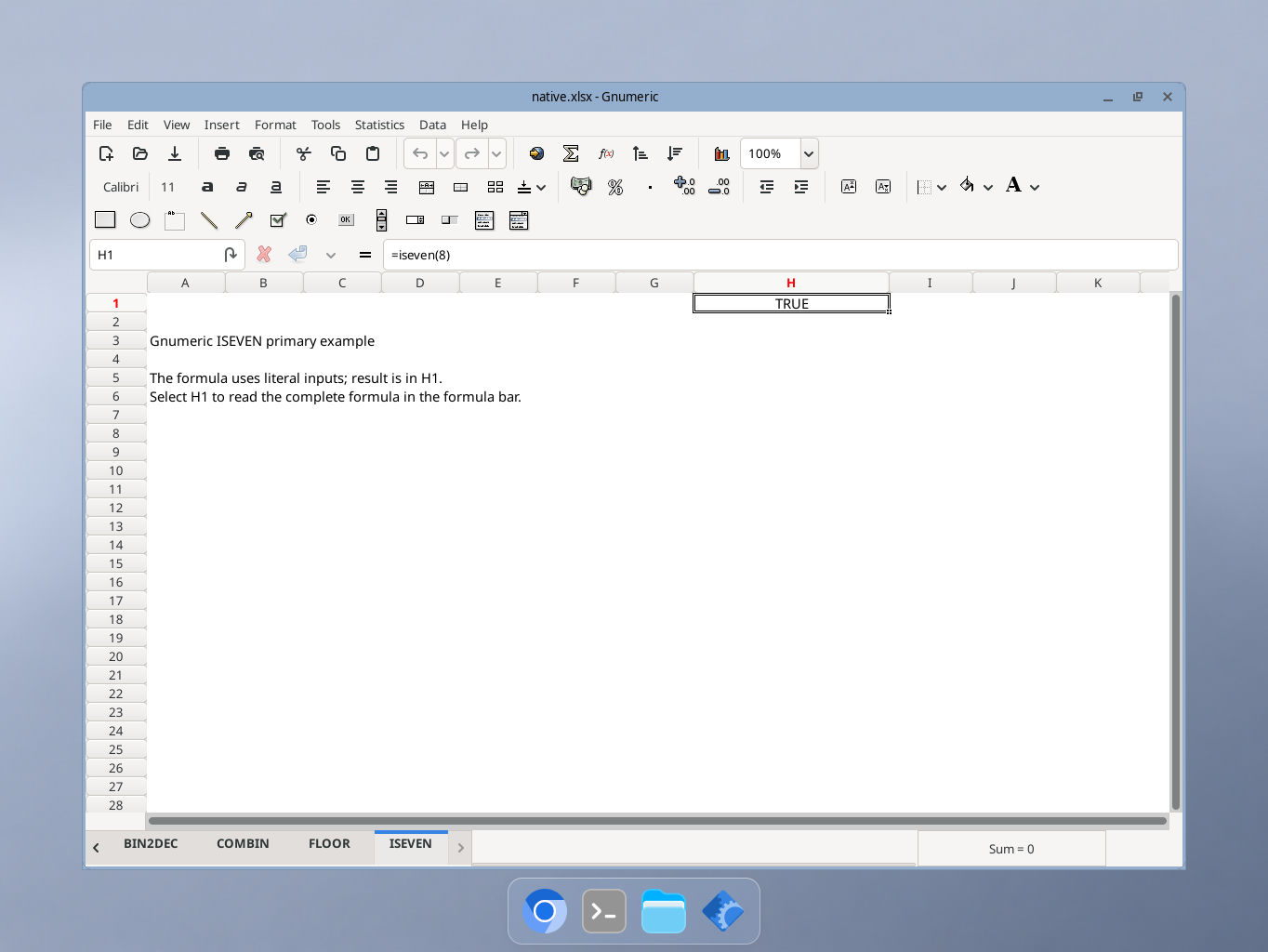
Gnumeric 1.12.57, captured 17 October 2026. The selected H1 cell shows the primary example result, with its formula in the formula bar. The literal inputs are visible in the formula bar. The GUI locale was not independently recorded.