

YIELD Function (Gnumeric)
Learn the YIELD function in Gnumeric: Returns the yield on a security that pays periodic interest.
Verification status: See the evidence and test scope described in this guide. How formula examples are checked
YIELD solves for an annual yield associated with a periodic-coupon security’s quoted price. Its output is a decimal rate: 0.05 means 5%. It is different from the coupon rate, which specifies the payment amount rather than the discount rate consistent with the price. This is a synthetic spreadsheet tutorial, not an investment forecast.
Syntax and schedule
=YIELD(settlement,maturity,rate,price,redemption,frequency,[basis])
The first two arguments are dates. rate is the annual coupon rate; price is the quote per 100 face-value units; redemption is the amount repaid per 100 at maturity. frequency must be 1, 2 or 4. The optional basis defaults to 0, US 30/360. The documented alternatives are 1 actual/actual, 2 actual/360, 3 actual/365 and 4 European 30/360.
Do not supply the total market value of a large holding as price. A quote of 98.50 remains 98.50 even when the holding’s face value is 10,000. Likewise, enter a 5% coupon as 0.05. Coupon periods, date convention and price units must agree before an inverse calculation can be meaningful.
A par-price control with an independent check
Put =DATE(2025,1,1) in A2, =DATE(2027,1,1) in B2, 0.05 in C2, 100 in D2, 100 in E2, 1 in F2 and 0 in G2. Use:
=YIELD(A2,B2,C2,D2,E2,F2,G2)
The expected result is 0.05, displayed as 5% after percentage formatting. The annual cash flows are 5 and 105. At a yield of 0.05 their present value is 5/1.05 + 105/1.05^2 = 100. This provides an independent arithmetic check rather than treating a matching label as proof of correctness.
As an analytical extension, a price of 98.16660733357065 corresponds to a yield of 0.06 for these same cash flows. That follows from 5/1.06 + 105/1.06^2, although the native fixture here tests the par-price case only. Keep the full unrounded quote if you use this extension as an inverse-price comparison; rounding to 98.17 slightly changes the solved yield.
Solver behavior and compatibility limits
For more than one remaining coupon, the inspected implementation solves a pricing equation using Newton iteration and a bisection fallback. Its search is restricted to nonnegative yields, up to an implementation ceiling of 1000. This matters for negative-yield instruments: a financially meaningful root outside the solver’s interval is not guaranteed to be returned.
For one or fewer remaining coupons, a separate direct formula uses day-count fractions. Do not generalize the multi-coupon solver bounds to every possible last-period result, or assume that equal names across applications imply identical search behavior. There is no user-supplied initial-guess parameter in this function.
Errors and practical diagnosis
The source returns #VALUE! for failed date conversion. Invalid frequency/basis, settlement after maturity, a negative coupon or price, and nonpositive redemption are rejected with #NUM!. A zero price is not rejected by the same front-end comparison; it is not a useful ordinary valuation input and subsequent calculation may fail. Failure to find a root in the numerical branch also returns #NUM!.
If you receive an error, first verify dates, positive price, and the price-per-100 convention. Next check whether the requested result lies outside the implementation’s solver range. Increasing displayed decimal places cannot repair an invalid input or missing root. A percentage format is only presentation; the underlying decimal remains available for subsequent calculations.
Verification scope and sources
On October 17, 2026, Gnumeric ssconvert 1.12.57 under C.UTF-8 recalculated the synthetic FinancialTraffic fixture. Native results were F3 = 0.049999999999999996. The earlier fixture uses the exact literal formulas described above. A separate native Gnumeric 1.12.57 screenshot below shows the primary example only. Other edge cases are source-derived unless explicitly identified as tested. No native 1.12.62 execution is claimed. Official 1.12.57 source was retrieved October 17, 2026. Original introduction and last functioning version are not established. Retained release history from the official 1.12.62 source was originally obtained October 13–14, 2026 and reviewed October 17; it is not a fresh runtime test.
Related Gnumeric guides
Native application screenshot
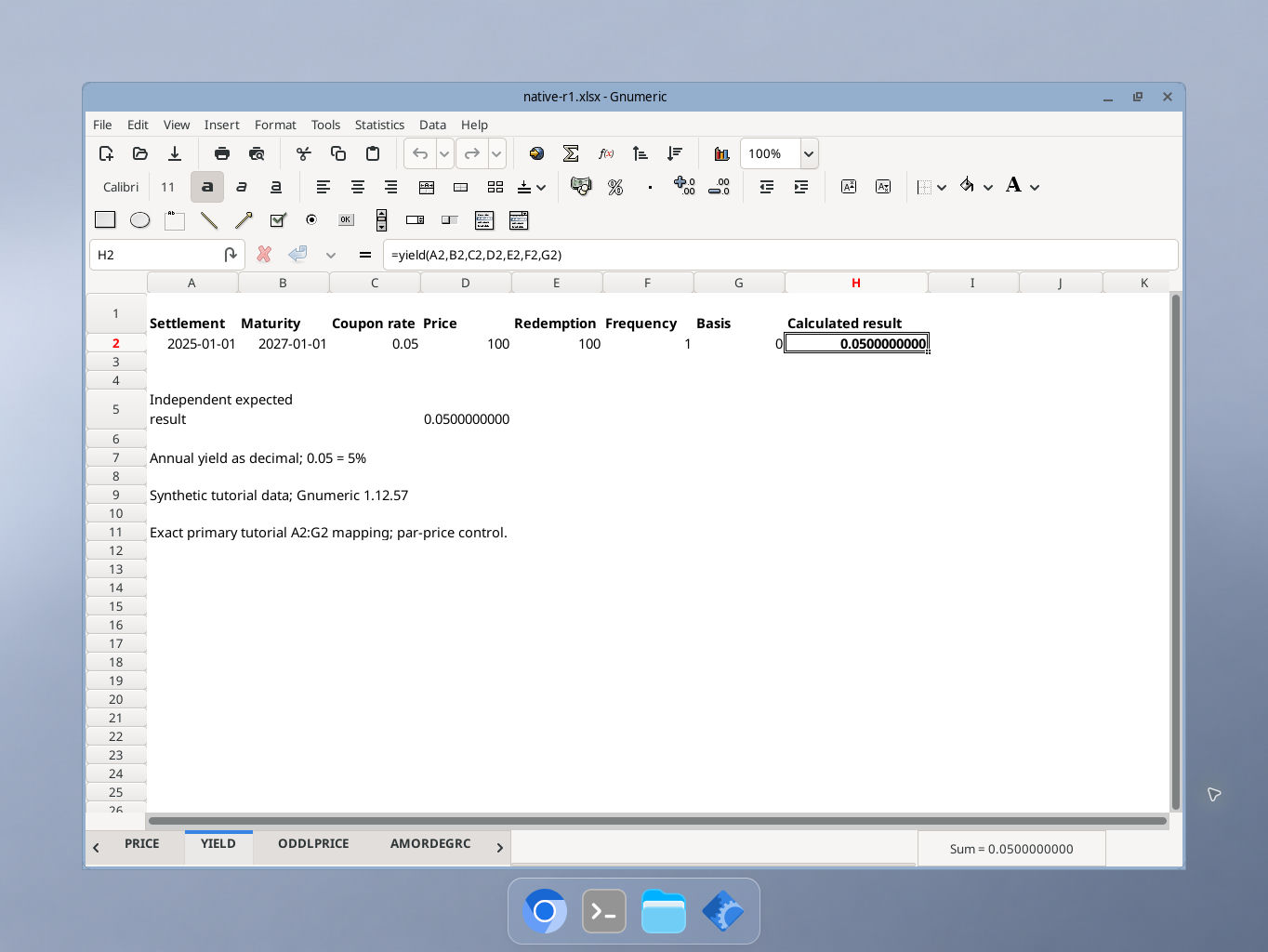
Gnumeric 1.12.57, captured October 17, 2026. Selected cell H2 shows 0.0500000000, or 5% annual yield. The formula bar and synthetic inputs are visible. GUI locale was not independently recorded; this capture covers the primary example only.