

Independent-means practice workbook for Gnumeric
Compare the same two independent groups with pooled t, Welch t and known-variance z formulas. This original workbook accompanies Compare Independent Sample Means in Gnumeric. It uses that guide’s synthetic numbers, but places them in A5:A9 and B5:B10, rather than the guide’s input positions. It is an editable worksheet, not a generated Analysis Tool report.
Downloads
- Editable native Gnumeric workbook (.gnumeric)
- Editable XLSX export (.xlsx)
- One-page PDF reference (.pdf)
Both workbooks contain the same single sheet, Independent means. Start with the native format when working in Gnumeric. The XLSX was reopened and recalculated in Gnumeric, not tested in Excel, Google Sheets or another application. This workbook relies on Gnumeric’s TDIST handling of fractional degrees of freedom; do not assume another engine will recompute identically. The PDF is static and will not update when you edit a workbook. No paid edition or subscription is needed. The workbooks contain no macros, scripts or external workbook links.
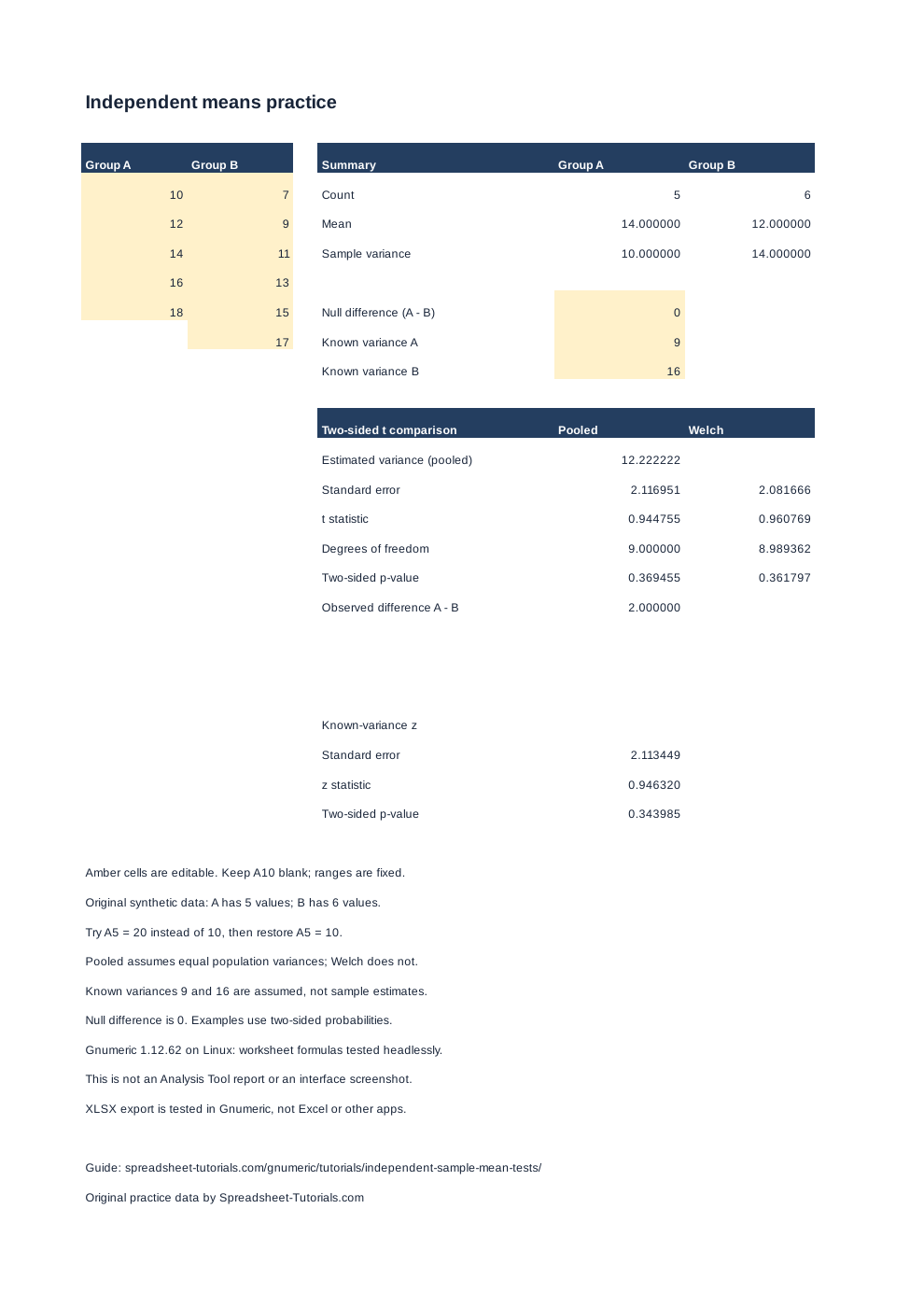
This is a native worksheet PDF export, not an application-interface screenshot. The image is a rasterization of the supplied PDF. No Gnumeric interface controls are shown.
Use the workbook
- Save a working copy and open it in Gnumeric.
- Amber A5:A9 contains 10, 12, 14, 16 and 18. Amber B5:B10 contains 7, 9, 11, 13, 15 and 17. Keep these numeric. A10 remains blank and is outside Group A’s fixed range.
- E9 contains the null difference, 0. E10:E11 contain assumed known population variances, 9 and 16, for the separate z example. These are not estimates from the entered samples.
- Read counts, means and sample variances in E5:F7. The pooled and Welch calculations occupy E14:F19. The z calculation occupies E24:E26.
- Select a result cell to inspect its live formula. For example, F18 is
=TDIST(ABS(F16),F17,2): a two-sided Student t probability with the Welch degrees of freedom in F17. Preserve that fractional value; do not round it to an integer before calculation.
Ranges are deliberately fixed at five and six numeric observations. Appending rows does not extend them. Keep sample sizes, numeric entries and the supplied variance assumptions for this exercise. This is not a general invalid-input validator. The underlying sampling and distribution assumptions are explained in the linked guide; a small p-value alone does not validate them.
Check the original results
Group A has mean 14 and sample variance 10; Group B has mean 12 and sample variance 14. The observed A minus B difference is 2.
| Calculation | Standard error | Statistic | Degrees of freedom | Two-sided p-value |
|---|---|---|---|---|
| Pooled t | 2.116951 | 0.944755 | 9 | 0.369455 |
| Welch t | 2.081666 | 0.960769 | 8.989362 | 0.361797 |
| Known-variance z | 2.113449 | 0.946320 | Not applicable | 0.343985 |
The displayed six-decimal results are rounded for reading. Formulas retain full working precision. Pooled t assumes equal population variances; Welch does not impose equality. The z case uses its separate known-variance assumptions. Do not choose a test simply because its p-value is smaller.
Change and restore one input
Change A5 from 10 to 20, keeping everything else unchanged. After recalculation:
- Group A’s mean in E6 becomes 16.
- Pooled p in E18 becomes approximately 0.091408.
- Welch p in F18 becomes approximately 0.086881.
- Known-variance z p in E26 becomes approximately 0.058406.
Restore A5 to 10. The original means and probabilities should return. These synthetic exercises compare formula behavior, not evidence for a consequential real-world decision.
Troubleshooting and test limits
If results do not change, check that you edited A5 in the workbook rather than the PDF, that the entry is numeric, and that the result cell still contains its formula. Recalculate the workbook before comparing values. If you changed another observation or assumption, restore the supplied example first. Do not replace calculated cells with the expected numbers.
Blank cells, text, zero variances and undersized samples are outside this exercise’s validated input set. A blank is not interchangeable with zero. This download does not certify coercion or error behavior.
The exact free runtime tested was Gnumeric 1.12.62 on Debian 13 Linux x86_64, built from official release sources. Base, changed and restored inputs were recalculated with formula caches removed, compared with a separate high-precision mathematical calculation, and the native .gnumeric file was reopened and checked. Gnumeric also produced the PDF headlessly. This does not establish graphical-dialog or Analysis Tool report execution, Windows behavior, current-latest-version behavior, or feature parity in another spreadsheet program. All unrelated unresolved function and interface holds remain outside this download.
Sources and related reading
- Independent sample means guide, including model assumptions and tool distinctions
- Official Gnumeric 1.12 release source directory
- NIST: two-sample t-test formulas
The dataset is original practice material reused from the companion guide. The native worksheet export depicts this project’s own workbook, not a third-party screenshot.