

COSH Function (Gnumeric)
Calculate hyperbolic cosine in Gnumeric with COSH, symmetry checks and a scaled catenary-height example.
Verification status: Fresh bounded Gnumeric 1.12.57 ssconvert tests; cached 1.12.62 source inspected separately; separate primary-example GUI capture below. How formula examples are checked
Exact syntax and meaning
=COSH(x)
COSH returns the hyperbolic cosine of one required real numeric argument x. Mathematically it is (EXP(x)+EXP(-x))/2. Unlike ordinary COS, it is not periodic; it is even, reaches its minimum of 1 at zero, and grows as the magnitude of x increases. Its input is dimensionless in the physical models below.
The original example =COSH(0) returns 1. Both =COSH(1) and =COSH(-1) return approximately 1.543080634815. The agreement is an immediate symmetry check; the sign of x does not change COSH’s result. This is different from the odd symmetry of SINH or TANH.
Advanced application: height above a catenary minimum
A scaled catenary can be written y=a*(cosh(x/a)-1), where a and x use the same length unit. For a=2 and horizontal displacement x=3, =2*(COSH(1.5)-1) returns approximately 2.704819230486 in that length unit. Put a in A2 and x in B2, then use =A2*(COSH(B2/A2)-1). This gives height relative to the lowest point rather than the unshifted a*cosh(x/a) coordinate. The formula is a geometric model, not a complete engineering design calculation.
Check a as positive before dividing. For symmetric displacements +x and -x the heights agree. This symmetry and the zero height at x=0 provide independent worksheet checks without requiring a separate expected value for every row.
Errors, range and troubleshooting
Nonnumeric text “bad” returned #VALUE! in the native fixture. Large magnitudes can overflow finite spreadsheet arithmetic even though COSH is mathematically defined for every real number; no exact overflow threshold is certified here. For very small x, subtracting 1 from COSH(x) can lose significant digits, so a displayed zero need not prove a geometrically zero displacement.
Do not convert a catenary ratio x/a with RADIANS or DEGREES. COSH is a hyperbolic function, and this argument is not an ordinary angle. If a chart looks sinusoidal or stays below 1, check that COS was not entered by mistake.
Native examples and expected results
=COSH(0)→ 1=COSH(1)→ 1.5430806348152437=COSH(-1)→ 1.5430806348152437=2*(COSH(1.5)-1)→ 2.7048192304864944=COSH("bad")→ #VALUE!
Availability, portability and evidence
The original introduction and last functioning release are not established. These examples were freshly recalculated in Gnumeric 1.12.57 on 17 October 2026. Retained 1.12.62 source, originally obtained on 13/14 October, was inspected separately; no execution of 1.12.62 is claimed. The desktop fn-math module must be available. Native output cells and formulas were independently read back and compared with Python mathematical identities to absolute/relative tolerance 1e-12. These fixture records are engine verification; a separate primary-example GUI capture appears below.
Ordinary real-number formulas have similar meanings in other spreadsheets, but identical names do not guarantee the same coercion, numerical range or error handling. The earlier comparable LibreOffice Calc 25.2 check is historical cross-program context; it is not evidence of Gnumeric execution. The fresh Gnumeric tests above supersede the earlier no-native-test status for these exact cases.
Related functions
First-party sources
Native application screenshot
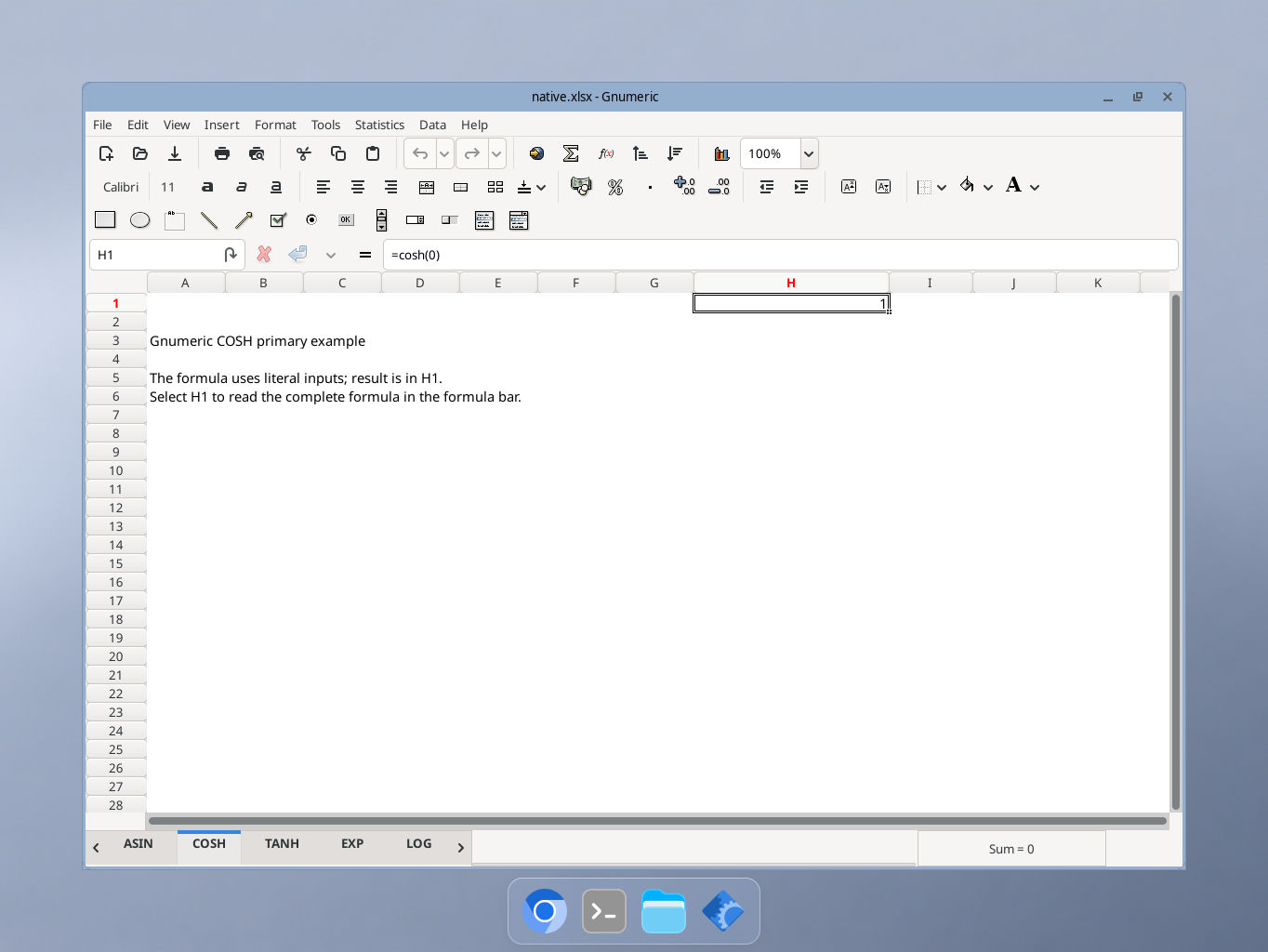
Gnumeric 1.12.57, captured 17 October 2026. The selected H1 cell shows the primary example result, with its formula in the formula bar. The literal inputs are visible in the formula bar. The GUI locale was not independently recorded.