

LOWER Function (Gnumeric)
Convert text to lowercase in Gnumeric with LOWER, literal versus cell inputs, accented examples and explicit casing limitations.
Verification status: Gnumeric 1.12.57 ssconvert bounded LOWER fixtures, with a separate primary-example GUI capture; retained 1.12.62 source inspected separately. How formula examples are checked
LOWER returns a lowercase version of text. It is useful for a display convention or a case-normalized comparison key. It does not remove spaces, punctuation, accents or other characters, and it should not be used to alter case-sensitive credentials or identifiers whose exact original spelling must be preserved.
Syntax and argument
=LOWER(text)
text is the sole required argument. There are no optional language, trimming or comparison-mode parameters. A literal string goes in quotation marks, while a cell reference is supplied without quotation marks. For example, =LOWER(A1) reads the cell; =LOWER("A1") changes the literal characters A1.
The retained implementation uses GLib’s UTF-8 lowercase conversion. The native examples below verify ASCII and a precomposed accented Latin word in the stated locale. They do not establish all language-specific casing rules or Unicode normalization equivalence.
Worked examples
The original =LOWER("HELLO") returns hello.
| Formula | Expected result |
|---|---|
=LOWER("LÉVY") |
lévy |
=LOWER("A1-B2") |
a1-b2 |
=LOWER(" NORTH-01 ") |
two spaces, north-01, two spaces |
Letters change case; digits and the hyphen do not. Spaces remain in place. Lowercasing an already lowercase string leaves the ordinary lowercase letters unchanged.
Put two leading spaces, NORTH-01, and two trailing spaces in A1. =LOWER(A1) preserves all four outer spaces. If you want the trimmed lowercase key, enter =LOWER(TRIM(A1)), which returns north-01 for this example.
Advanced use: keep an original label and a comparison key
When importing a category list, preserve the original text in column A and put =LOWER(TRIM(A1)) in B1, then copy down. Column A remains available for display and audit; column B contains a consistent key for the specified cleanup rule. “NORTH-01” and “north-01” then share a lowercase key, while different punctuation still remains different.
Lowercase conversion is not the same as a complete deduplication policy. Two names may differ by accents, internal whitespace or Unicode composition even after LOWER. Conversely, two distinct case-sensitive identifiers could collapse to the same key. Decide whether case is meaningful before merging records based on the result.
Do not overwrite original contact names just to simplify a lookup. A helper key is usually safer than discarding the original capitalization. For automatic comparisons, confirm whether the comparison function already ignores case; LOWER may then be a presentation preference rather than a necessary computational step.
Troubleshooting
- Unexpected extra spaces are not a LOWER failure. The function changes case only; use a deliberate whitespace rule when appropriate.
- LOWER does not remove accents: É becomes é in the tested example, not e.
- A numeric value displayed with a special format is not guaranteed to carry that visual formatting into a text transformation. Keep fixed-width codes as text if leading zeros matter.
- Input errors propagate; lowercasing does not repair missing references or invalid source formulas.
- Do not assume one-letter-to-one-letter conversion or identical results for every language and locale without testing the actual text.
- The result is text. Arithmetic, dates and quantities should retain separate numeric source values rather than being converted solely for display.
Availability and version history
- Introduced: Documented by 1.12.62; original introduction not established.
- Availability: Supported in Gnumeric 1.12.62, based on the function-specific registration.
- Scope: Desktop; the fn-string function module must be included and enabled.
- Source provenance: Official 1.12.62 source retained October 13–14, reexamined October 17, 2026. No new native execution of that release.
Related functions
Official sources
Native verification scope
On 17 October 2026, Gnumeric 1.12.57 ssconvert recalculated 5 bounded LOWER fixtures in C.UTF-8. The retained original example and additional fixture outputs matched their independently checked text/position expectations, including the explicitly tested error and empty-string cases where listed. These fixture records are engine evidence; the separate primary-example GUI capture below does not certify untested Unicode sequences, size extremes or other versions. Explanatory combinations not present in those fixtures are logical checks, not claimed additional native runs.
Native application screenshot
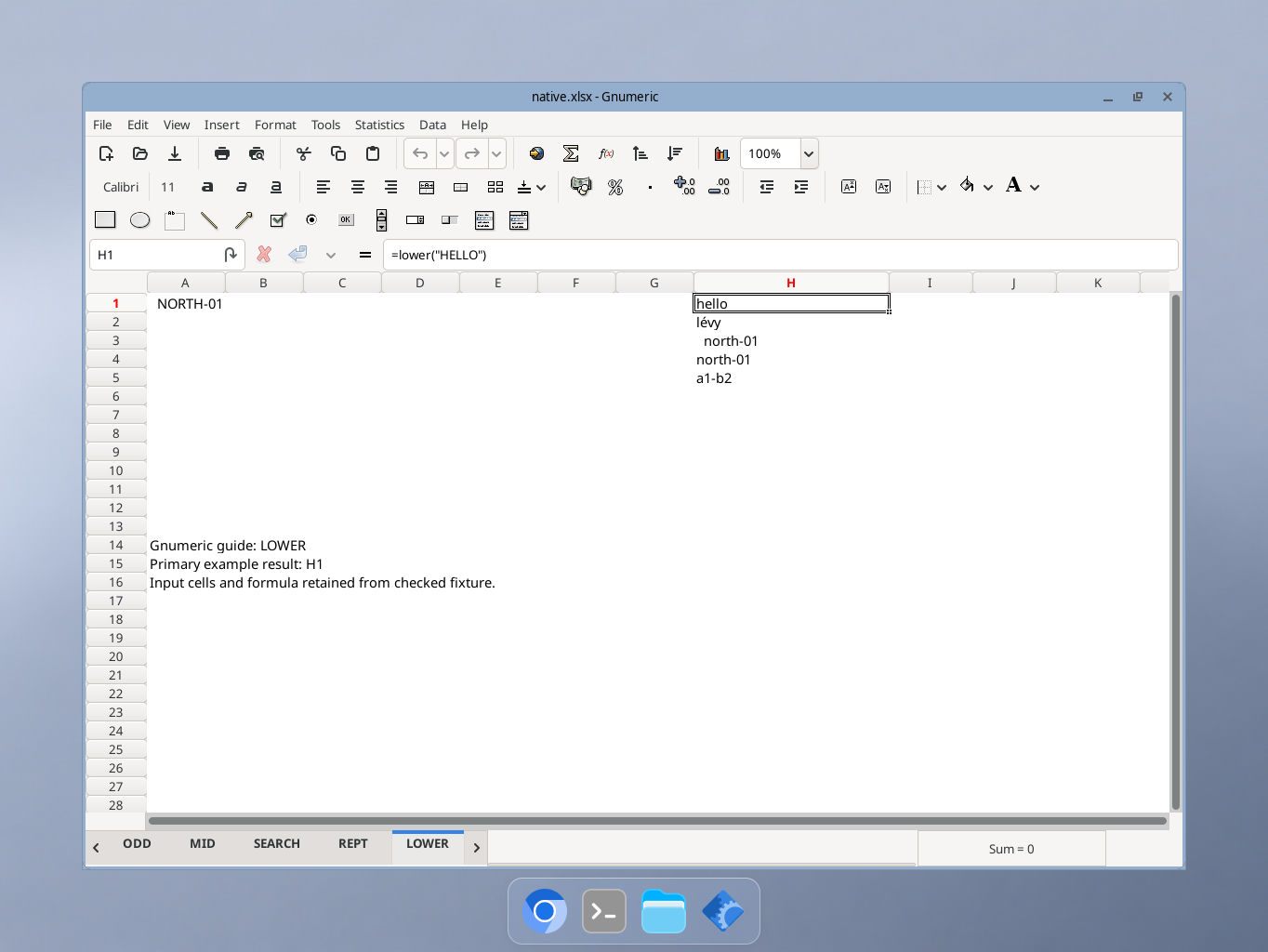
Gnumeric 1.12.57, captured 17 October 2026. The selected H1 cell shows the primary example result, with its formula in the formula bar. Other visible rows are supplemental fixture cases. General number formatting preserves floating-point tails; the GUI locale was not independently recorded.