

ODD Function (Gnumeric)
Round to odd integers away from zero in Gnumeric with ODD, negative values, zero and practical integer-allocation checks.
Verification status: Gnumeric 1.12.57 ssconvert bounded ODD cases, with a separate primary-example GUI capture; retained/pinned 1.12.62 source inspected separately. How formula examples are checked
ODD rounds a number away from zero to an odd integer. It does not test whether the input is odd, and it does not select the nearest odd integer by distance. Existing odd integers are retained; positive and negative non-odd values move outward in magnitude.
Syntax
=ODD(x)
The single required argument x is numeric. There are no optional arguments, digit-count defaults or step-size parameters. Use an ordinary scalar formula and press Enter; an array-output selection is not needed for these examples.
Worked examples and zero boundary
The original =ODD(4) returns 5. The next odd integer with magnitude at least 4 is 5.
| Formula | Expected result |
|---|---|
=ODD(-4) |
-5 |
=ODD(5) |
5 |
=ODD(0) |
1 |
=ODD(-0.2) |
-1 |
The zero case is a special practical boundary: Gnumeric chooses positive 1. A very small negative value instead rounds to -1. Do not infer that ODD preserves zero or always increases the signed number.
The negative example also distinguishes ODD from a ceiling toward positive infinity. For -4, a less negative odd integer would be -3, but rounding away from zero selects -5. If your goal is simply to test parity, use an appropriate logical parity test rather than comparing the rounded result casually with the input.
Advanced use: a centered window
Suppose a centered analysis window must have an odd number of positions so that there is one center and equal counts on each side. Put a requested minimum width of 8 in A1. In B1 enter =ODD(A1) to obtain 9 positions. In C1 enter =(B1-1)/2 to obtain 4 positions on each side of the center.
If A1 is already 5, the window remains 5 with two positions on each side. This rule assumes a positive requested width. ODD accepts negative inputs mathematically, but a negative window length is not a valid application input. Validate the requested width before using the result to select data.
The same construction can size an odd grid with a central cell. For a square grid with nine cells along each side, the total is 9² = 81, not nine. Be explicit about whether x is a one-dimensional width, a total count or a physical distance before rounding it.
Errors and troubleshooting
- ODD has no second parameter. To control decimal places, use a decimal-rounding function instead.
- Positive fractions between successive odd integers round outward to the larger odd integer; this is not ordinary nearest-value rounding.
- An already odd integer remains unchanged. “Next odd” does not require adding 2 every time.
- Input errors propagate rather than becoming a rounded number. Keep source-validation errors visible.
- Floating-point numbers at magnitudes too large to represent every integer cannot preserve ordinary unit-by-unit parity reasoning. The bounded cases here do not certify that extreme range.
- Formatting a number without decimals does not make it an odd integer. Use the function’s returned value for subsequent calculations.
Availability and version history
- Introduced: Documented by 1.12.62; original introduction not established.
- Availability: Supported in Gnumeric 1.12.62, based on the function-specific registration.
- Scope: Desktop; the fn-math function module must be included and enabled.
- Source provenance: Official source retained on October 13–14 and examined again October 17, 2026; core PRODUCT source freshly retrieved at the same pinned revision. No new 1.12.62 native execution.
Related functions
Official evidence
Native verification scope
On 17 October 2026, Gnumeric 1.12.57 ssconvert recalculated 7 bounded ODD cases in C.UTF-8, including the original worked example and the specific additional formulas covered above. Numerical differences from exact arithmetic are limited here to floating-point rounding. These fixture records are engine evidence; the separate primary-example GUI capture below does not certify other versions or extreme inputs. Any additional explanatory arithmetic is independently checked, rather than represented as another native run.
Additional retained documentation
Native application screenshot
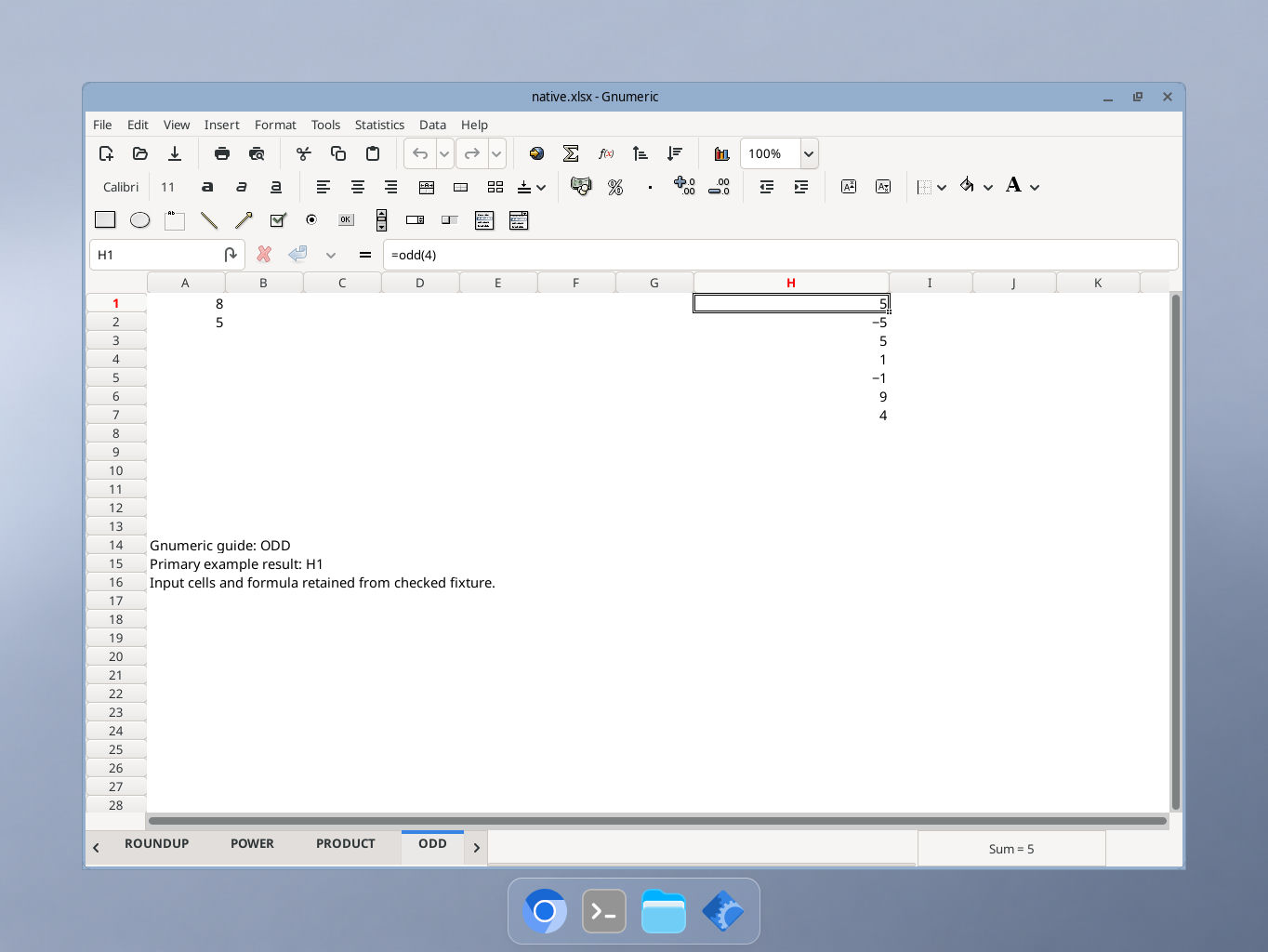
Gnumeric 1.12.57, captured 17 October 2026. The selected H1 cell shows the primary example result, with its formula in the formula bar. Other visible rows are supplemental fixture cases. General number formatting preserves floating-point tails; the GUI locale was not independently recorded.