

POWER Function (Gnumeric)
Raise values to powers in Gnumeric with POWER, its optional integer-root argument, negative-base domains and reproducible calculations.
Verification status: Gnumeric 1.12.57 ssconvert bounded POWER cases, with a separate primary-example GUI capture; retained/pinned 1.12.62 source inspected separately. How formula examples are checked
POWER raises a base to an exponent. Gnumeric also supports an optional third argument for an integer root of that powered value. That extension is useful for odd roots of negative numbers and should not be omitted when documenting Gnumeric’s full syntax.
Syntax and numeric domain
=POWER(x,y[,z])
x is the required base and y the required exponent. Optional z defaults to 1 and must be a positive integer. The function first forms x raised to y, then takes its z-th real root. For positive x this corresponds mathematically to x^(y/z), but that rewritten expression does not always have the same accepted domain for negative x.
A negative base requires an integer y. If the intermediate result is negative, an even z is invalid because there is no real even root. The function returns a real number, not a complex-number string.
Worked examples
The original =POWER(2,3) returns 8, since 2×2×2 = 8.
| Formula | Expected result |
|---|---|
=POWER(16,0.5) |
4 |
=POWER(2,-3) |
0.125 |
=POWER(-8,1,3) |
-2 |
=POWER(1000,1,3) |
10 |
A negative exponent represents a reciprocal: 2^-3 = 1/8. The three-argument negative-cube-root example is particularly useful: =POWER(-8,1/3) instead returns #NUM! in the tested Gnumeric build because its exponent is not an integer. Do not assume that writing a decimal approximation of one-third tells the function to select a real cube root of a negative base.
Advanced use: repeated growth factors
For a starting value of 100 and three successive periods of growth at 5%, enter =100*POWER(1.05,3). The expected result is 115.7625. The growth factor is 1.05, not 5 and not 0.05. The calculation is 100×1.05×1.05×1.05.
If rates differ by period, raising one factor to the number of periods is no longer the same model; multiply the separate period factors instead. Likewise, the exponent’s period count and the rate’s period must agree. A monthly rate with a year count is a unit mismatch, even if the spreadsheet produces a number.
For geometric scaling, use =POWER(1000,1,3) to recover the side length 10 of a cube with volume 1000. A negative volume would need a meaningful signed mathematical interpretation before applying an odd root; physical dimensions cannot be justified by formula syntax alone.
Errors and troubleshooting
=POWER(0,0)returns#NUM!in Gnumeric’s examined implementation.=POWER(0,-1)returns#DIV/0!because it asks for a reciprocal of zero.- A negative base with noninteger y returns
#NUM!. - Zero, negative or fractional z is invalid and returns
#NUM!in the accepted-base branch. Supply a positive integer root degree. - A negative intermediate value with even z returns
#NUM!rather than a complex result. - Very large powers can overflow before a later root is applied. The three-argument form is not a guarantee against intermediate overflow.
- Do not assume another spreadsheet supports Gnumeric’s third argument. The guide verifies Gnumeric’s behavior, not cross-product formula portability.
Availability and version history
- Historical evidence: POWER is listed among the changes and new features in official NEWS for 0.17; the root-of-negative-number extension is recorded in 1.11.90. These milestones do not certify every intermediate release.
- Availability: Supported in Gnumeric 1.12.62, based on the function-specific registration.
- Scope: Desktop; the fn-math function module must be included and enabled.
- Source provenance: Official source retained on October 13–14 and examined again October 17, 2026; core PRODUCT source freshly retrieved at the same pinned revision. No new 1.12.62 native execution.
Related functions
Official evidence
Native verification scope
On 17 October 2026, Gnumeric 1.12.57 ssconvert recalculated 10 bounded POWER cases in C.UTF-8, including the original worked example and the specific additional formulas covered above. Numerical differences from exact arithmetic are limited here to floating-point rounding. These fixture records are engine evidence; the separate primary-example GUI capture below does not certify other versions or extreme inputs. Any additional explanatory arithmetic is independently checked, rather than represented as another native run.
Additional retained documentation
Native application screenshot
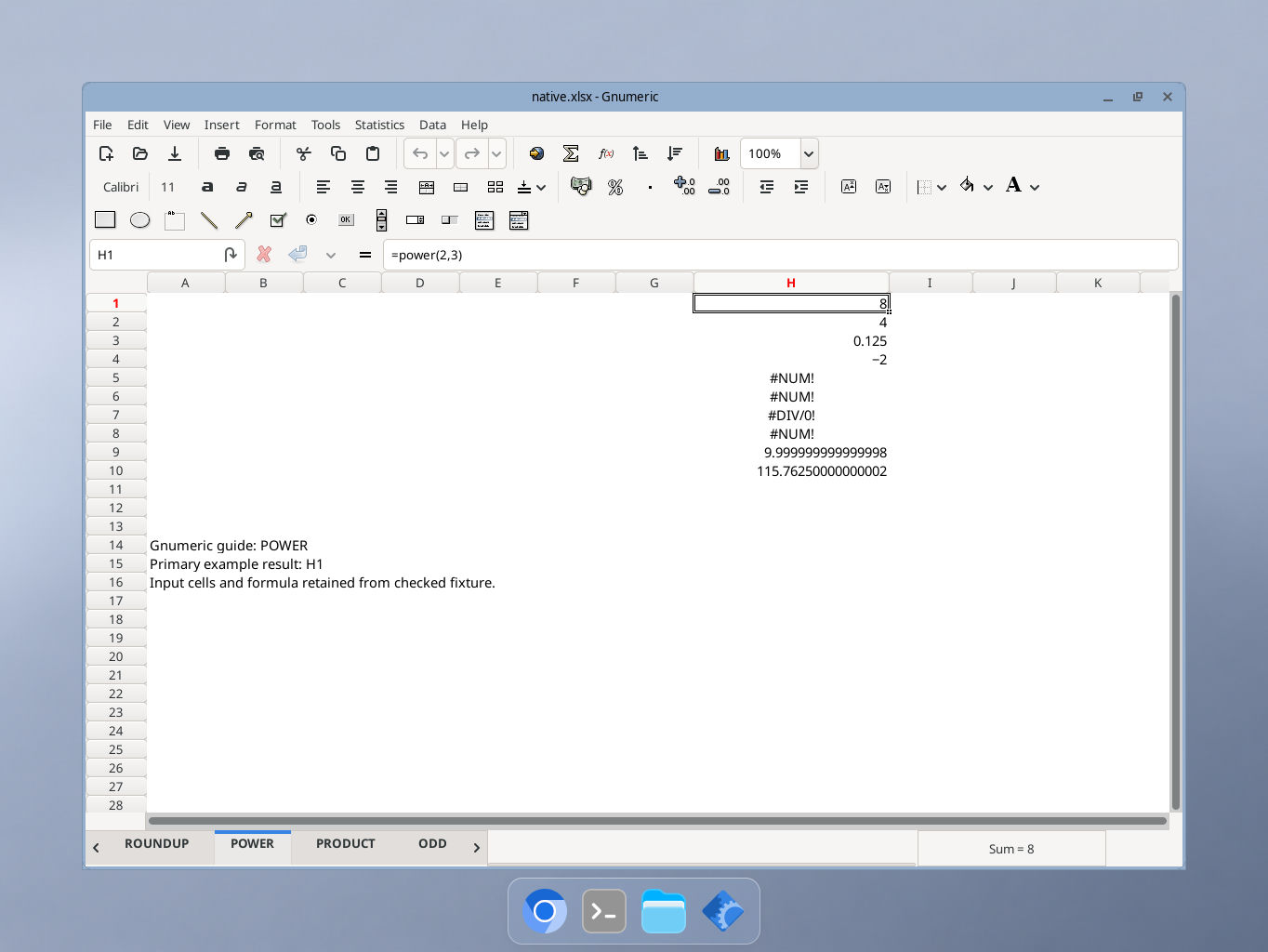
Gnumeric 1.12.57, captured 17 October 2026. The selected H1 cell shows the primary example result, with its formula in the formula bar. Other visible rows are supplemental fixture cases. General number formatting preserves floating-point tails; the GUI locale was not independently recorded.